
Climate Change
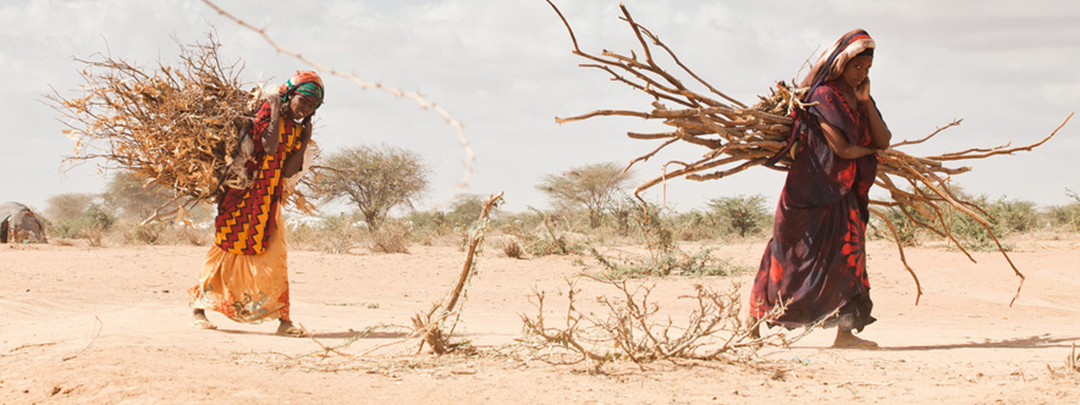
Climate change is increasingly recognized as a global threat to peace. Effective responses to conflict prevention and peacebuilding in affected countries and regions require strengthening social inclusion and leveraging the agency of women – especially local women – who are on the frontlines of climate change.
Climate change impacts people’s abilities to perform gender roles; in fragile and conflict-affected contexts, different forms of insecurity and violence can emerge when these gender roles are frustrated. At the same time, climate change can also contribute to social shifts that lead to new responsibilities and opportunities for women and men in economic decisions and activity, political engagement, community arbitration, and mediation.
Responses to climate change are also gendered. Decisions about or related to climate change are most often taken by (elite) males, and thus do not systematically consider how they may impact the security and livelihoods of other genders, and males who are less privileged. Furthermore, they rarely take into account how gender roles have been impacted by climate change or how opportunities to strengthen political and economic gender equity could be supported through climate-related decisions.
Until recently, however, significant gaps in our understanding of how gender, natural resources, climate, and conflict are linked have constrained effective responses. Over-simplistic analysis of gender has also been an obstacle, leading to important oversights in understanding how different identities – gender and otherwise – intersect and compound marginalization. These oversights have serious implications for understanding the security risks and implications of climate change and its responses, like preventing the outbreak, escalation, continuation, and recurrence of conflict.
Key Resources
The Women, Peace and Security Agenda and the Climate Crisis: Inextricable Links
This talk was presented as part of the research seminar, African Perspectives on the 20th Anniversary of UNSCR 325 - Gendering Peace and Security, The…Climate Change in Women, Peace and Security National Action Plans
This SIPRI Insights paper explores how the Women, Peace and Security (WPS) national action plans (NAPs) of 80 states frame and respond to climate change…Women and Climate Change: Impact and Agency in Human Rights, Security, and Economic Development
This report comes at an important time of international observance when new commitments to action will be made, coinciding not only with the fifteenth anniversaries…Gender and Environmental (In)Security: From Climate Conflict to Ecosystem Instability
For decades, scholars, policy makers, and the media have discussed the connections between security and climate change. These actors have utilized various discourses and narratives…Gender, Conflict, and Global Environmental Change
Gender has long been identified as an important variable in both conflict (de-)escalation processes and vulnerability or adaptive capacity toward global environmental change. We understand…Women’s Resilience to Disasters Knowledge Hub
The WRD Knowledge Hub brings together a network of people who support women and girls affected by disasters and climate change.We champion women’s agency and…
Resources
Women Building a Resilient World: Implementing a Just Transition and Fossil Fuel Phaseout
Event
Please join us this Climate Week in New York City for an inspiring and solutions-oriented WECAN event, "Women Building a Resilient World: Implementing a Just…
Women’s Leadership: Cultivating Health and Harmony for People and Planet
Event
Join us for a powerful and inspiring afternoon exploring what it means to be healthy—individually, collectively, and as a living planet. Frontline and Indigenous women…
Nigeria: Mercy Corps Strengthens Peacebuilding Efforts for Women, Youths in Katsina Communities
International
Women and youth from four Local Government Areas of Katsina State have begun a four-day training aimed at strengthening their capacity to prevent conflicts, resolve…
Protecting Women Environmental Defenders: Lessons from Colombia
Blog
For women environmental defenders, protecting the environment is inseparable from peacebuilding, protecting human rights, and territorial survival. In Colombia, where I am from, women environmental…
Breaking Barriers to Sustain Youth Participation in and Beyond Brazil
Library
The global media coverage of the youth climate movement has ignited debate on how to meaningfully engage youth in political decision-making. While not all youth…
De la presencia al poder
Spotlight
De la presencia al poder No se trata de si las mujeres están en la sala, sino de si las mujeres deciden Almuerzo de Liderazgo de Mujeres,…
From Presence to Power
Spotlight
From Presence to Power Not whether women are in the room, but whether women decide Women's Leadership Lunch, June 18, 2026, Ottawa · Quotes are drawn from…
Ethics of Care in Environmental Peacebuilding — a Draft to Build on Together
Announcement
When we gathered in Ottawa, we held a workshop on the ethics of care in environmental peacebuilding. The conversation was rich, but we have tried…
Indonesia: Changing Tides: How Women Seaweed Farmers in Indonesia Are Adapting to Climate Change
International
Before sunrise, Fatmawati Palele is already by the sea.
Growing up in Sulamu, a coastal community in East Nusa Tenggara, Indonesia, the ocean has always shaped…
Guatemala: Indigenous Women Build Climate Resilience with Old and New Farming Methods
International
Lake Atitlán is one of Central America’s most critical local sources of drinking water, and is surrounded by volcanoes, a thriving tourism industry and an…
Fiji: Gender, Environmental and Social Safeguards (ESS) Officer (Regional Tuna Programme – Programme Management Unit)
Job
The Pacific Community (SPC) is the principal scientific and technical organisation in the Pacific region, supporting development since 1947. We are an international development organisation owned and…
Peru: Women Elevating the Role of Bees in Conserving Amazonian Biodiversity
International
Like Lesli, a group of Indigenous and rural women in the Oxapampa–Asháninka–Yánesha Biosphere Reserve (BIOAY), located in the Pasco region, are leading a quiet yet…
Bamyan (Central Afghanistan): Drought, Displacement, and a Deepening Humanitarian Crisis
International
The United Nations has warned that worsening drought, severe food insecurity, and restrictions on women and girls are deepening Afghanistan’s humanitarian crisis, leaving millions of…
From Presence to Power: Women Environmental Peacebuilders Connect
Event
Join us for an intimate gathering that brings together women at the forefront of environmental peacebuilding—from community mediators to policy advisors, Indigenous leaders to researchers.…
Meet the 2026 Goldman Environmental Prize Winners
Blog
Each year, the Goldman Environmental Prize is awarded to grassroots environmental champions from around the world.
Afghanistan: Solar-powered Greenhouses Enable Afghan Women to Grow Food, Income, and Hope
International
For seven years after her husband died, Noorhaya, 45, toiled under the harsh sun in Kandahar Province, southern Afghanistan, trying to grow enough vegetables to…
Afghanistan: Water Crisis in Qaisar: Women and Children Bear the Heaviest Burden
International
Residents of Qaisar district in Faryab province have raised concerns about the shortage of safe drinking water and the lack of sufficient water for farming…
The Rush for Critical Minerals Is Reshaping Communities. Gender Analysis Helps Show Who Pays the Cost.
Spotlight
There are troubling trends at both ends of the minerals supply chain. On one end, communities across the Democratic Republic of the Congo (DRC), Lithium…
Somalia: Girls Face Heightened Risk as Hunger Crisis Worsens
International
Somalia is facing a deadly hunger crisis made worse by soaring food and fuel prices linked to the Middle East conflict; a years-long climate change induced…
South Africa: Climate Change Hits South African Women Unevenly: Why Race, Class, Age and Power Matter
International
As heat, floods and drought intensify, governments, donors and cities rely on climate risk assessments to decide who gets support and where money goes. A…
Global: Women Deliver 2026: Voices from The Pacific on Feminist Leadership and Resourcing
International
Across the Pacific, women’s and feminist movements are leading transformative change in the face of climate pressures, shrinking civic space, fragile economies, and limited access…
Global: African Women Push for Reparations and Environmental Accountability after Landmark Climate Justice Day
International
Women’s community organizations and grassroots movements across Africa are intensifying calls for climate reparations and environmental accountability following the inaugural African Women’s Climate Justice Day,…
UNFCCC Gender Action Plan & CBD Gender Plan of Action
Report
The Rio Conventions - the United Nations Framework Convention on Climate Change (UNFCCC), the Convention on Biological Diversity (CBD), and the United Nations Convention to…
Taking Out the Trash: Tourism Waste, Women’s Environmental Insecurity, and the Foundations of Community Fragility in Coastal Asia-Pacific
Spotlight
It’s August in Boracay, Philippines. The beach bars, restaurants and luxury resorts are packed with revellers and tourists — up to 2.1 million visiting in…
Global: OSCE Tackles Gender and Climate Change Nexus
International
A major OSCE conference in Vienna brought together experts to examine the gendered dimensions of climate change and associated security risks across the organization's 57…
Niger: How Community Shelters Protect Children and Help Women Restore Degraded Lands in Niger
International
Washington, USA, 03 April 2026 -/African Media Agency (AMA)/- Community-built shelters in Niger are enabling mothers to participate in land restoration work by providing shaded…
Liberia: New, Community-Led Conservation Delivering Promises
International
Years ago, women in Wedjah and Jaedae Districts in Sinoe County processed cassava with their bare hands. Their story has changed for the better. They…
Circular, Equitable, and Renewable: Scrutinizing Mineral Requirements to Build a Just Energy Transition
Policy Brief
The scope of this policy brief examines the implications of decarbonization, specifically focusing on mining related to renewable energy development; it also identifies some of the critical…
Climate Change, Resource Conflicts, and Rural Women's Empowerment in Nigeria Amid Democratic Erosion: A Feminist Political Economy Perspective
Library
The crises of climate change, resource conflicts, and the decline of democracy significantly impact the empowerment of rural women in Nigeria's agrarian areas. There is…
Toward Gender-responsive Forest Governance and Climate Actions in Myanmar: Insights from a Systematic Review
Library
This study presents the first systematic review of gender dynamics in forest and climate governance in Myanmar, aiming to synthesize existing knowledge, identify research gaps,…