
Climate Change
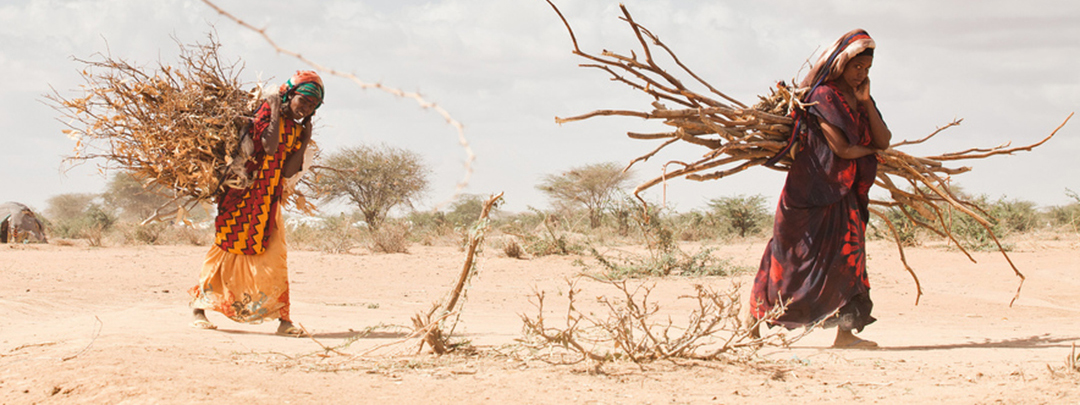
Climate change is increasingly recognized as a global threat to peace. Effective responses to conflict prevention and peacebuilding in affected countries and regions require strengthening social inclusion and leveraging the agency of women – especially local women – who are on the frontlines of climate change.
Climate change impacts people’s abilities to perform gender roles; in fragile and conflict-affected contexts, different forms of insecurity and violence can emerge when these gender roles are frustrated. At the same time, climate change can also contribute to social shifts that lead to new responsibilities and opportunities for women and men in economic decisions and activity, political engagement, community arbitration, and mediation.
Responses to climate change are also gendered. Decisions about or related to climate change are most often taken by (elite) males, and thus do not systematically consider how they may impact the security and livelihoods of other genders, and males who are less privileged. Furthermore, they rarely take into account how gender roles have been impacted by climate change or how opportunities to strengthen political and economic gender equity could be supported through climate-related decisions.
Until recently, however, significant gaps in our understanding of how gender, natural resources, climate, and conflict are linked have constrained effective responses. Over-simplistic analysis of gender has also been an obstacle, leading to important oversights in understanding how different identities – gender and otherwise – intersect and compound marginalization. These oversights have serious implications for understanding the security risks and implications of climate change and its responses, like preventing the outbreak, escalation, continuation, and recurrence of conflict.
Key Resources
The Women, Peace and Security Agenda and the Climate Crisis: Inextricable Links
This talk was presented as part of the research seminar, African Perspectives on the 20th Anniversary of UNSCR 325 - Gendering Peace and Security, The…Climate Change in Women, Peace and Security National Action Plans
This SIPRI Insights paper explores how the Women, Peace and Security (WPS) national action plans (NAPs) of 80 states frame and respond to climate change…Women and Climate Change: Impact and Agency in Human Rights, Security, and Economic Development
This report comes at an important time of international observance when new commitments to action will be made, coinciding not only with the fifteenth anniversaries…Gender and Environmental (In)Security: From Climate Conflict to Ecosystem Instability
For decades, scholars, policy makers, and the media have discussed the connections between security and climate change. These actors have utilized various discourses and narratives…Gender, Conflict, and Global Environmental Change
Gender has long been identified as an important variable in both conflict (de-)escalation processes and vulnerability or adaptive capacity toward global environmental change. We understand…Women’s Resilience to Disasters Knowledge Hub
The WRD Knowledge Hub brings together a network of people who support women and girls affected by disasters and climate change.We champion women’s agency and…
Resources
Human Rights, Security, and National Adaptation Plans Nexus: A Holistic Approach to Women and Human Mobility
Event
What happens when climate adaptation, human rights, and security intersect? How can National Adaptation Plans (NAPs) better protect the rights of women and climate-displaced communities?Join…
La erosión de la infraestructura estadounidense en temas relacionados con medio ambiente, género y construcción de paz.
Spotlight
Hace un año, Marisa Ensor esbozó la creciente codificación del campo de la construcción de paz ambiental y sus reconocidas intersecciones con la raza, el…
Gender, Climate and Conflict: Women Building Resilience in Bangladesh’s Fragile Zones
Blog
Following June 2024’s flash floods, when over 2.1 million Sylhet and Sunamganj inhabitants lost all, they had, Shaharima Sharna emerged. A LoGIC community mobiliser, she…
Bangladesh: Climate Change Threatens Women’s Health
International
Climate change is severely affecting the physical and psychological health of reproductive-age women living in Bangladesh’s coastal communities, according to a new study. The research,…
Africa: African Women Are Key to Fighting Climate Change: These Are the Green Skills They Will Need
International
Women are an important and often underutilised human resource in Africa. They’ve faced many problems historically. Limited access to land, finance, education and decision-making platforms…
Brazil: The Ecofeminist Movement Is Surging. Here’s What Its Advocates Want
International
It was an audacious moment. During a recent government hearing, allies of former President Jair Bolsonaro berated Brazil’s environment and climate minister, telling Marina Silva she…
Climate, Peace and Security in Eastern Democratic Republic of the Congo
Library
Local communities in eastern Democratic Republic of the Congo (DRC) face the combined challenge of climate change and violent conflict, which exacerbates vulnerabilities, poverty, displacement…
Securing Women’s Land Rights: A Pathway to Food Security
Blog
Despite playing a central role in food systems, women lack secure land rights in more than half of all countries, posing serious implications for food…
Nepal: Centring Women’s Knowledge and Leadership in Nepal’s Climate Response
International
Indira Dhital, a local woman leader from Kavre, central Nepal, recently recited this poem at the culmination of a UN Women project focused on building…
Sweden: OSCE Workshop Tackles Gender, Climate, Security
International
How gender intersects with climate-related security risks was one of the questions explored by experts and practitioners at the "Gendered Perspectives on Climate and Security:…
Why Gender-Responsive Action Must Anchor Africa’s Climate Summit 2025
Blog
As Africa prepares to convene in Addis Ababa for the second Africa Climate Summit (ACS) in September 2025, the continent stands at a critical intersection.
The…
India: Indigenous Women and their ‘Dream Maps’ Seek to Protect Lands from Climate Change
International
At a small stream in India’s eastern state of Odisha, Indigenous villagers catch eels and fish for a dinner celebrating an annual harvest festival. The…
Brazil: Consultoria Nacional Sênior para a Promoção da Agenda de Gênero e Clima
Job
Antecedentes/Contexto
A ONU Mulheres, com base na visão de igualdade consagrada na Carta das Nações Unidas, trabalha para a eliminação da discriminação contra mulheres e meninas;…
Mexico: With Innovations, They Protect Maize Biodiversity
News
Rural women in Quintana Roo have been guardians of maize for generations. Today, with sustainable innovations and the support of technicians like Esmeralda Andrade, they are strengthening their role in food…
International: How Gender Inequality and Climate Change are Interconnected
International
The climate crisis is one of the most pressing issues of our times. It threatens to reverse progress on human rights and sustainable development and…
Climate Change and Gender-based Violence in Colombia: Peacebuilding, Feminism and the Special Jurisdiction for Peace
Library
Climate change's devastating effects exacerbate pre-existing conditions of vulnerability, including gender-based violence. For historically marginalized groups in Colombia (i.e., Indigenous and Afro-descendant communities, peasants, women,…
Building Resilience through Climate Action: Gender, Peace, and Security in Sri Lanka
Briefs & Development
Sri Lanka is at a crossroads. The impacts of climate change are becoming increasingly visible, with erratic rainfall, prolonged droughts, and rising sea levels disrupting…
Bridging Policy and Practice: Key Insights from the Water, Peace and Climate Conference in Kenya
Blog
Have you heard the tale of a hummingbird saving a huge forest from a fire? While all other animals fled in fear and panic, the…
L'Entraide en Temps de Crise : Étude de Cas Tchad
Library
This case study was chosen because Chad is one of the most vulnerable countries and the least prepared for climate change, and is very frequently…
Kyrgyzstan: FAO Supports Women's Initiative in Batken Region to Cultivate Rose Hips on Degraded Land
International
Nestled in the picturesque slopes of the Pamir-Alay mountains, Batken Region in southwestern Kyrgyzstan faces significant challenges due to its harsh continental climate, arid conditions,…
Gender, AI, and Disaster Response: Navigating the Risks of Technological Innovation Amidst Climate Breakdown
Spotlight
The frequency and severity of climate-related disasters has risen alongside a growing deployment of artificial intelligence (AI) to improve disaster response and recovery operations. Disaster…
Kenya: Women Step Up Environmental Conservation Efforts in Suba South
International
A group of women in Suba South Constituency has embarked on raising tree seedlings for planting this rainy season. Dubbed the Sindo Tree Nursery Women Project,…
Women’s Land Rights: The Missing Key to Climate Action
Blog
This year’s International Women’s Day theme, #AccelerateAction, calls on the world to address the structural barriers slowing progress. If we are serious about climate, we…
Global: How Funders are Addressing Climate-Driven Violence for Women Workers
International
Climate change is a threat multiplier, amplifying existing risks and vulnerabilities, including structural inequality and workplace exploitation, which has been found to drive more extreme…
How six women are helping their communities adapt to climate change
News
This piece highlights impactful women-led climate change initiatives around the world. As climate change intensifies, its impacts disproportionately affect women due to existing gender inequalities.…
How six women are helping their communities adapt to climate change
News
This piece highlights impactful women-led climate change initiatives around the world. As climate change intensifies, its impacts disproportionately affect women due to existing gender inequalities.…
How six women are helping their communities adapt to climate change
News
This piece highlights impactful women-led climate change initiatives around the world. As climate change intensifies, its impacts disproportionately affect women due to existing gender inequalities.…
How six women are helping their communities adapt to climate change
News
This piece highlights impactful women-led climate change initiatives around the world. As climate change intensifies, its impacts disproportionately affect women due to existing gender inequalities.…
Global: Women and Girls are at the Heart of Fostering Better Agrifood Systems for All
International
Gender equality has never been more important. Thirty years after the Beijing Declaration, a landmark United Nations resolution to promote gender equality, progress on women’s rights…
How Six Women are Helping their Communities Adapt to Climate Change
Blog
As the planet warms, the fallout from climate change – from droughts, to floods, to superstorms – is getting worse. But not everyone has felt…